


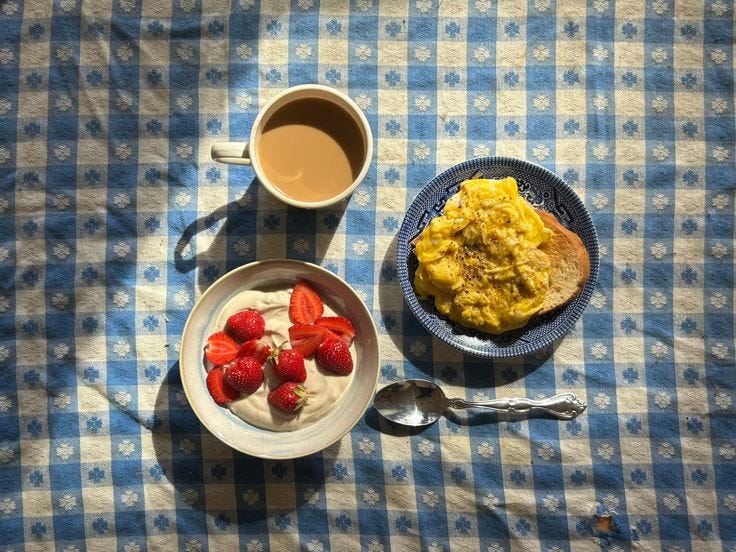

Congratulations to Michelle Hromin for having their following essay chosen for publication on Blank Canvas Post. The essay that follows is a truly wonderful exploration of the intention and exploration. Please read the follow conversation between us at Blank Canvas Post and Michelle Hromin to understand more about the writer and the context for this brilliant essay.
To read the work of other brilliant writers of every discipline, and to join our community of creativity, empathy, and togetherness, please consider subscribing and pledging your support to Blank Canvas Post.

Writer Spotlight: Michelle Hromin.
Originally from New York, USA and Croatia, Michelle Hromin has been committed to her practice of writing for her whole life.
What was it that made you start writing?
As a kid I really just loved making up my own stories while also exploring things like having crushes or the big thoughts I was having about the world. My dad was also writing a book when I was a kid, and something about that process of him always at his desk really stuck with me.
What experiences have you had that have shaped the writer you are today?
Definitely my being a musician as my main career path has led me to opening up more as a writer. I was, and always have been, questioning things about the industry and found that through writing I was thinking about my own creativity, and what that means in both a musical and non-musical context. To add to this, being from Croatia while growing in New York was extremely formative for my relationship to writing. I somehow always felt like I was in the middle.
What genres are you writing at the moment? What genres do you enjoy writing?
I’d say I mainly write longer form essays but I have been dabbling with some short stories and speculative fiction!
What inspires you to write? Where do you take your inspiration from?
Daily life mostly - even just doing simple tasks like going for groceries opens up my mind to think about things that are bothering me, or to really be present in the world around me.
What does your writing process look like (e.g., environment, tools, setting)?
I do a mixture of writing by hand, usually adopting a specific notebook as my ‘writing notebook’ and I carry a miniature notebook in my bag to write down any notes about what I’m reading or things I notice. I always write on my computer in bursts throughout the week.
What do you envisage when you are writing something new? Are you writing with the intention of sharing your work, or are you simply writing to write, for example?
It’s a mixture - I think my inspiration behind writing is just to write, and for the writing itself, finding answers to questions I have posed myself, but then at times I feel like when I’m writing or I have an idea for a story, my way of moving through it is doing something like publishing it on Substack or submitting it for opportunities, thinking of it as an extension of myself that lives in the world as well.
Why do you think community is important for writers and creative people?
Writing can feel very solitary and isolating! I think feeling a sense of community and supporting other people’s work is some of the best things that we can do in a world that needs more safe spaces to create, and to nurture one another.
Where do you currently share you work?
On Substack and via a few journals! I have a few pieces coming out in TEMPO, I Care If You Listen, the Hampstead Literary Society, and Balkanism later this year.
Why did you submit your work to Blank Canvas Post? What drew you to our publication?
I loved the supportiveness created by Blank Canvas Post, and it felt like a great step in feeling more part of the writing community as well.

About the Essay: 24 Hours in Zagreb.
Regarding 24 Hours in Zagreb, what inspired you to write this piece?
I recently went on field work near one of the villages I am from in Croatia and took a last-minute trip to Zagreb as part of my research. Something about the trip, particularly making the last-minute call to go to the ethnography museum with all of my things, was really special.
What is the context for this piece? What is the main feeling or message behind it?
There’s a few things - going back to Croatia after not being able to travel for a long time for this project, which is a new work based on Zadar’s Sea Organ for clarinet and electronics, was extremely special in itself, and filled with a lot of emotions. I also went through a lot of my family archives as part of my work, and the process of engaging with these materials felt like a first step towards the work I’ve always dreamed of doing.
What was the process of writing this piece like for you? What did this process look like?
It sort of all came at once - I guess this piece acts as a sort of closing off of this first part of the work but is also an invitation into what is to come.
Why did you choose to submit this piece specifically to Blank Canvas Post?
I really appreciate the wonderfully supportive writing space BLANK CANVAS POST offers!

So, without further ado, here is 24 Hours in Zagreb, an essay by Michelle Hromin.
24 Hours in Zagreb, by Michelle Hromin.
I have woken up in a little flat in Zagreb, the snow still perched neatly on windowsills and dangling off the shingles of the roofs. I am deliriously awake, taking what felt like 4 languid naps throughout the night to total about 11 hours of sleep, nearly half a day of rest dissected by thick, wild dreams, some seeming so real I had to wake myself up and some so comfortably fake that I gleefully let myself go along with the story line. I love moments like these, waking up after sleeping in a new bed, not really knowing where I am but noticing myself sprawled out on the bed like a starfish, feeling around for my glasses and squinting to see a sleek, miniature coffee machine looking back at me, resting on the desk across the room.
I am approaching the end of a period in my life marked by a trip to the zraćna luka, to the airport, and the micro-preparations beforehand, which bus to get, which train, where should I lay things in my suitcase, which pocket shall I put my portable charger, thoughts like these, both said aloud or running around my internal monologue bookending the trip in mind. This trip, my first to Croatia in winter, has been a long time in the making, originally planned for warmer walks in September or October, for direct flights to Zadar and wearing shorts while I did the work I set out to do, recording the Sea Organ built in 2005, but was delayed because of visas and processes and things I finally feel like I don’t have to talk about so circularly, things that exist as if in the air but not needing to be the first thing that I address to someone, and yet I have found myself unexpectedly in Zagreb, a wonderful detour because of the Ethnography Museum and, even more of a surprise to myself, a craving to not rush, to leave my bags somewhere and to walk freely, to think, to be, to go to Zagreb slightly early to have time to take it what has just happened, the entirety of my trip, to take stock of my work, to take hold of myself.
After a long day of travel from London down into Petrčane last Sunday I did not expect myself to do exactly what I did - to act in certain ways, yes, to move down the roads in the only way I know how, to hug close to the walls until my hands are opening the gates to Dido’s house, yes, to feel the familiar jingle of pink ključ in my pocket, to twist and and turn the handle and hear the door’s rubber frame grittily slide against the bottom of the floor, being so specific to say, we are here, this is Dido’s house on the corner of Ulica X, yes. Within minutes I found myself in the basement, preparing myself to go ‘through things’, oblaći, in some way, my fingers feverishly flicking through documents and both imaginary and real dust floating into the air as I laughed at the treasure trove I had found in between plastic crates and woven baskets- photos of my family I had known so intimately because of their presence on printed calendars and Christmas cards, photos of people I didn’t and will maybe never know, the stills of dinner parties I knew happened and others new to my eyes that gave me a glimpse into the world they had, the lives they shared in the years before I was a even a consideration, and now, part of this lineage, engrossed in its complexities. Maybe this is why I like the Sea Organ itself because I like its texture and brooding amongst the crashing waves, its persistence and eventual quieting before what feels like a storm ready to burst, its broad exasperations forcing you to settle, to sit for just a moment, if you will, to think before you before think about speaking, and so I did, I thought and thought and held his old car keys in my hands, I thought while driving down to the organ itself and in the cicada-less streets of a mostly tourist-free Zadar, I thought while cutting myself slices of cheese as a reward for finding the words, for sitting with the recordings, for making sense of what I was meant to be doing now that it had all worked out.
In the thick of my Baba’s floral plates that I’ve been eyeing since I could barely see above the kitchen counter and carpentry tools, big saws and industrial sized choppers decorating edges of walls between old tables and furnishings Dido had made, I found a series of photos of my great-grandfather Dido Šime and his son Dido Mario aging so gracefully, naturally preserved through the sharp edges of neatly cut passport photos. It only felt right to line them up in order and study them, finding a way to organise photos around them and understand where I came from, people I have known in my 26 years of life in its various forms and stages. A series of Polaroids jumped out of the bottom of a green plastic bin showing the skeleton of the very house I am in before it was built, land bought and passed down, the tree extending its arms into the villages where we come from, leading paths to where we will stay for a while. When I read back to what I wrote about doing this, of going to Zadar to record the Sea Organ, there are musings about what people would have seen, what they would have heard, how my own family would have interacted with the Sea Organ and who of them had over the years, and it made sense, in the way that a public space belongs to the public, the Sea Organ belongs to us, my people, moja obitelj.
There is a scene towards the end of Sentimental Value that seems to play on repeat in the back of my mind during quiet moments of the day, the flashing shutter flicking from the face of daughter to father, to imaginations of family that exist in the years and generations before and after. It appears for a mere few seconds before vanishing into the next section and remains one of the beauties of the films, its ability to articulate the fragmentary nature of familial relationships at times, and to hold care for each of the characters navigating their role and grief in the family, analyzed between the places we hold inside ourselves, a house that bears meaning, a stretch of road I have shuffled my feet against, the riva where the Sea Organ sits.
In looking at these photos I have collected I see this so clearly, there is an archive in what I have done this week; in sitting next to each slot of the organ I have helped to preserve something fixed in time, the nature of its musics over the course of 3 days, its fixture in the riva as something to take in, chat over, congregate around, fulfilling its position as a place to gather. The same applies to these photos, these tracings of my family over the years, eating, laughing, celebrating, mourning, these snapshots capture a further understanding about the people I come from, the place that exists in front of and within me, and yet so much to discover because of the nature of the snapshot, with the knowledge that something much larger exists, something that I get to carry with me as I tell you this story, as I bring the archive from my home in Croatia to my home in London.
After bundling up warm I found myself walking around Zagreb thinking about these photos, with signs like FOTOCENTAR and FOTO NOW staring back at me in big block capitals, and I could feel between myself fiddling with the little red plastic sleeve that held my Didos’ passport photos in my pocket. Before I knew it I was untwisting the blue and white scarf I knitted but hadn’t bothered to block, wrapped tightly around my neck to cover every crevice, to not get propuh, and smoothing my hair in front of a digital camera on a tripod. The guy looked perplexed, he knew I needed passport photos but he didn’t know why they had to be passport photos, and why they had to be now. I say I did not expect myself to do all of these things but I know myself, I know the archive that I carry inside of me, that I learn and reflect and look for ways of preserving the language, the memory, the thing against my heart.
I will use these photos, I think, when I send off my American passport to be renewed soon. For now it feels nice to have time stand still, to remember the cold of that day in Zagreb, to feel the aroma of Baba Bložos’ perfume around the cabinets in the house, to create the beginning of an archive that says something about my people, not just the ones in my family but what our region means, how we lived, and where we will go next, me and my recordings, my photos and my people, moja obitelj.

Share your thoughts…
Support the writing community, help it to grow and become a positive space for all the writer’s sharing their wonderful work. Let this writer know your thoughts.

Check this out!
We share monthly posts on literary bodies, small presses, and writing contests that are open for submissions in the upcoming months (with occasional addition writing opportunity related posts to come soon too!)
In case you missed it…
Here are three recent posts by three wonderful writers that have been shared recently on Blank Canvas Post. We loved reading them, and think you will too. Check them out and show each writer some love!



Want to have your writing published?
Blank Canvas Post are OPEN for submissions. Submit your latest writing, of any discipline, to us here, by completing a Google Form.
Check our recent posts to review our submission guidelines and to see other literary bodies who are also currently open for submissions.
Thank you, Michelle - Zagreb really came alive and I'm also a musician who writes (poetry) and have a friend in Zagreb who I met in Berlin but have not yet visited...you make me want to go!