



Congratulations to Fari - Chihiro - for having their following literary fiction piece chosen for publication on Blank Canvas Post. The fiction piece that follows is a truly wonderful exploration of introspection and self-destruction. Please read the follow conversation between us at Blank Canvas Post and Chihiro to understand more about the writer and the context for this brilliant fiction piece.
To read the work of other brilliant writers of every discipline, and to join our community of creativity, empathy, and togetherness, please consider subscribing and pledging your support to Blank Canvas Post.

Writer Spotlight: Fari.
Originally from Pakistan, growing up in Saudia, Chihiro has used writing for catharsis since childhood. Over the last four years, they have shifted their focus, translating their raw thoughts and unresolved feelings into more structured poetry and literary forms.
What was it, if anything, that made you start writing?
It actually started in 2nd standard. I had an incredible English teacher who pushed me to explore my creative side, and that’s where my love for stories began. Later on, when I dealt with a lot of anxiety and depression that felt impossible to explain to the people around me, writing became my anchor, it was the only way I could sort myself out. I immersed myself in classic literature to understand the world better, and my ‘ramblings’ eventually turned into structured poetry. For a long time, social anxiety kept my work hidden, but recently I decided I wanted to be productive and have something to be proud of. I finally started sharing my writing, starting with my sister, and I’m finally open to feedback.
What experiences have you had that have shaped the writer you are today?
What shaped me most was the experience of being surrounded by people who loved me, but who fundamentally couldn't understand my struggle with anxiety and depression. Because of their backgrounds, those things were just 'concepts' to them, not a reality. Being diagnosed was a humbling and isolating experience because I realized that even with a supportive crowd, I was essentially on my own in navigating my mental health.
I started writing because I needed to make sense of what was happening to me. I didn't want to become someone who didn't understand. Writing became the only 'person' I could truly talk to, especially since social anxiety makes it so hard to build new friendships. It’s evolved from a survival tool into a way to make sure that through my poetry and literature, someone else out there might feel seen the way I didn't.
What genres are you writing at the moment? What genres do you enjoy writing?
I write across the boundaries of confessional poetry, psychological prose, and contemporary gothic literature. My work explores the anatomy of isolation, specifically the experience of being ‘loved but not seen’ and the ways mental health shapes one’s perception of time and the body. I utilize vivid, often visceral imagery to bridge the gap between internal ‘ramblings’ and structured literary exploration, focusing on themes of inheritance, memory, and the terror of beauty.
What inspires you to write? Where do you take your inspiration from?
My inspiration is largely opportunistic and observational. I tend to pull from whatever is in my immediate line of sight or hearing, a striking lyric, a fragment of dialogue from a stranger, or even a random passing sight. I’m fascinated by how a single quote or an intriguing subject can act as a catalyst for a much deeper internal exploration. To me, writing is the process of taking those external sparks and ‘aligning’ them with my own feelings and opinions to see what kind of truth comes out.
What does your writing process look like (e.g., environment, tools, setting)?
My process is rooted in atmospheric consistency. I always start by finding a specific song that captures the exact emotional frequency of what I’m trying to express, and I’ll keep that single track on repeat for the entire duration of the session. This creates a sensory loop that anchors me to the feeling and prevents my mind from wandering.
As for my environment, I prefer solitude and low light, usually a dimmed room where I don’t feel the pressure of the outside world. I allow the initial draft to be a raw, unfiltered 'flow' of whatever comes to mind. Once the emotion is captured, I shift into a more analytical mode to refine the language, ensuring the structure and alignment reflect the original intent. My tools are simple: a pen and journal are my preference for the tactile connection they provide, but I’m always ready to capture a sudden spark on my phone if inspiration strikes while I’m on the move.
What do you envisage when you are writing something new? Are you writing with the intention of sharing your work, or are you simply writing to write?
When I begin a new piece, I envisage a space of absolute honesty, a place where the feelings that were dismissed as mere 'concepts' in my daily life can exist in their full, heavy reality. For a long time, I wrote with no intention of sharing. I wrote to survive, to anchor myself during bouts of anxiety, and to create a record of my own existence when I felt alienated to the much known surroundings. I was writing to 'sort myself out' and to build the understanding I wasn't receiving from my environment.
However, my intention has evolved. I realised that keeping my work hidden was a symptom of the very social anxiety I was trying to navigate. Now, I write with a dual purpose: I still write to process the 'unresolved,' but I also write with the intentional goal of being productive and seen. I want to create something I can finally be proud of a tangible piece of literature that stands as proof of my growth.
I envisage a reader who, like me, might feel 'that humans their feelings and what they can do are too vast to be left unexplored.' I write to bridge that gap, turning my private 'ramblings' into an aligned format so that my internal world can finally meet the external one. I’m no longer just writing to exist; I’m writing to communicate.
Why do you think community is important for writers and creative people?
A creative community provides a mirror that we can’t provide for ourselves. When we are too close to our own work, we only see the 'messed up' parts or the 'ramblings.' A community helps us see the beauty and the structure in our own chaos. It gives us something to be proud of. Without that feedback, it's easy to stay stuck in a loop of self-doubt; with it, we find the courage to refine our craft and actually 'align' our thoughts into something professional.Community acts as a bridge. It’s the difference between writing to survive and writing to connect. When I finally shared my work with my sister and saw her reaction, it changed my perspective, I realized that my 'internal ramblings' could actually resonate with another human being. Community turns a private anchor into a collective lifeline.
I remember when I finally shared my work with my sister and saw her reaction, it changed my perspective, I realised that my 'internal ramblings' could actually resonate with another human being. Community turns a private anchor into a collective lifeline.
Where do you currently share you writing?
Currently, my primary home for my writing is Substack, where I enjoy the intimacy of connecting directly with readers. I have also had the privilege of being published in a literary magazine, which was a significant step in my journey toward sharing my work more broadly. While I previously explored Medium, I soon realised the platform didn’t quite align with the tone and direction of my work. I’m now focused on spaces that prioritise depth and a more personal, ‘aligned’ literary format.
Why did you submit your work to Blank Canvas Post? What drew you to our publication?
I submitted to Blank Canvas Post because I felt a strong alignment between my style and the publication’s aesthetic. My work focuses on the themes of isolation and the anatomy of feelings that are often hard to name, and I’ve found that Blank Canvas Post provides a platform for exactly that kind of ‘internal’ storytelling. I wanted to share my work with an audience that appreciates the beauty in the struggle of becoming oneself.

About the piece: Threadbare.
Regarding Threadbare, what inspired you to write this piece?
The inspiration for THREADBARE was sparked by a singular, haunting quote by the poet Anna Akhmatova in her poem called The Sentence: 'I have a lot of work to do today; I need to slaughter memory, turn my living soul to stone, then teach myself to live again.'
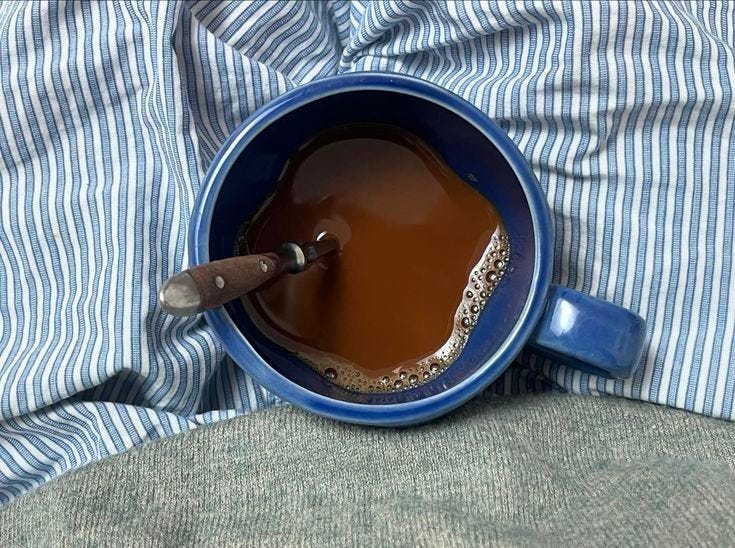
That line resonated with me on a visceral level because it perfectly captured the 'labor' of my own life. I’ve spent so much time using writing to navigate a world that didn't understand my mental health, and Akhmatova’s words gave me a framework for that struggle. I wanted to expand on that 'work' to explore the actual, messy, and often violent process of dismantling a pained past to make room for a future. The piece became an exploration of what it looks like to actually 'slaughter' those ghosts and the quiet, defiant act of teaching oneself to finally enjoy the sun and something as simple as a cup of coffee again.
What, if any, is the context for this piece? What is the main feeling or message behind it?
The core feeling of the piece is radical, exhausted agency. It begins with the feeling of being haunted and 'threadbare', worn down by memories and a body that feels 'borrowed.'
However, the message isn't one of defeat. It’s about the realisation that if the world won't see your pain, you must be the one to 'slaughter' the ghosts and 'stitch' a new self together. It’s the transition from being a victim of your own mind to being the architect of your own peace. The final message is one of hard-won hope: that after the 'slaughter' of a thousand internal ghosts, you can finally earn the right to simply exist, to taste your coffee, feel the sun, and wake up without an apology for being alive.
What was the process of writing this piece like for you? What did this process look like?
The process of writing THREADBARE was unlike anything I’ve experienced before. It felt less like 'writing' and more like a physical act of extraction; with every sentence, it felt as if I were ripping away pieces of my old self to see what lay beneath.
Usually, I am very focused on structure and 'aligning' my thoughts, but this piece demanded a different approach. I wrote it in a singular, relentless flow, refusing to take breaks because I didn't want to lose the intensity of the emotion. I stayed inside the 'fever' of the poem until the very last word was down.
When I finally finished, I felt a profound sense of pride. I realised this piece was a significant 'step up' from my previous work, it moved beyond simply words and became a structured, visceral piece of almost myself. It was the moment I felt yes this is it.

Without further ado, here is Threadbare by Chihiro.
Threadbare by Fari.
Morning arrives without mercy. I wake with a ledger of ghosts pressing against my ribs, teeth clenched around names I am no longer allowed to speak. My hands are already bloody, though I do not remember lifting the knife. It almost makes me want to cry. Memory gnaws at me like vermin trapped inside the walls of my skull, and I know that if I hesitate, it will consume me, yet a pulse persists, faint, stubborn, alive.
But I have work to do today. Work that demands a steady hand and an unflinching heart. Today I must be cruel. I must crack open my own chest and salt the inside so nothing tender dares to grow again. I have to gut remembrance, turn my warm, begging soul to stone, and set it somewhere no one can touch it, so it never tastes the warmth of hands not my own. Yet there’s a tremor, a flicker that refuses to be consumed. So soft, it almost seems a mistake of sight.
Today, I must petrify my living soul mid pulse, destroy it before it starts to fuel the broken bridges my mind has begun to rebuild, even as my eyes sting with unwelcome moisture. I must dismantle the shattered pieces of my spectre, the one that once swore never to be cast out. I have to burn the threads running through my body before they start pumping forsaken crimson again, blood that feels too foreign to be mine.
There’s a strange warmth in the morning today. It settles against my skin, eerily soft, as if the day is offering me a gentle farewell, considerate, almost tender toward my aching being. The rays catch in my eyes and make me look almost existent, almost alive, and so I turn away from them. Today I do not need pity. I need a strong hand, one that does not hesitate, one that pushes me toward the sea.
I must reach the shore today, sail the ship, and cast away the ashes of my incinerated nerves, so they never reach another core to torment. Only then can I grieve my soul with a smile, waving the hazy destructiveness away.
I woke with a strange devotion to slaughter bound to my being. A craving for ruin. A sickening will to carve myself inside out beneath the hazy sunlight peeking through my curtains. Crows caw relentlessly, dismantling what little mortal euphoria remained. Four perch by my window, watching, alive. Four for birth, I remember. Almost as if they know the ritual before I do.
I want to drown the past in gasoline that refuses to settle, strike the match myself, and watch it burn in the mirror. I want to witness my being fracture until it no longer recognises its own reflection. Then gather the ashes. Stitch them into a body too unfamiliar to ache. A body that learns only what it chooses. Smiles when it pleases. Sings without devastation.
In the morning, I slip beneath the water, letting venom-laced echoes cradle me instead of sweet nothings. I hold my breath through infinity, cataloging the vivid shards slicing through vision. My eyes remain bare, letting insight bleed in and out, rinsing what must not linger. One by one, the tight buttons of old attachments unthread, and I rise, lighter, untethered, afloat.
By evening, I must book myself a grave, dug by my bare hands, clawing until no trace of skin remains, only raw, glistening red. I have to feel the pain so these unclaimed hands never dare to reach out again toward the hopeless shadows carved by threaded light.
I must make it eighteen feet deep, so by the time I reach the bottom I am nothing but grotesque meat, too mangled to scream for rescue, too ruined to ever be retrieved. And yet, even there, at the marrow of ruin, there will be a tremor, a pulse that does not turn into silence.
It will stir beneath the wreckage, fragile and absurd, and begin to thread itself through the hollowed spaces of what I once was. From the rot, something new must gather, something that does not ache the same, does not bleed in the same way.
Before that, I must move through the day half translucent, a ghost threading warped edges. Every sound stretches.
Every touch arrives too late...
I hear people articulate and feel their words peel away, useless and unbinding, slipping through me like a misty haze. I relearn the choreography of the living. When to nod. When to swallow. When to pretend the burning has ceased. How to perform existence as if I were released, a marionette undone yet never deceased.
I drift through hours collecting fragments of speech that crumble between my fingers. Movements rehearsed. Expressions opaque. Every step a rehearsal. Every glance a quiet surrender for the play I am curating. I am present and yet absent, stitched to the living with invisible veins. Only darkness promises release, but I must wait for the sun to withdraw before I can begin sewing myself again.
I made a vow yesterday... a promise to gather myself again, forget the mortal delusions, the need to become something that aches, to rise with the sun, embrace its grace, let it touch my skin for the warmth I traced. Let the stars align as I lay in solace, look in the mirror with a new admiration for drifting haze.
There is a moment when the body forgets its vows. When breath settles. When the pulse steadies. When something like peace grazes the surface. I crush it immediately. Mercy is a weed. If left unattended, it roots. I cannot afford softness while memory still knows my name, at least not before I have gained my aid.
So, tonight I will drag myself to the dug grave and leap in so my bones can fray. I need to be completely in pieces when I let myself drift away so that by morning I am incapable of holding the threads of memory still trapped in frame. I must open my replaced eyes to the dew and not crave the strain I carried the day before. I have to wake again in a stitched up body, too deformed to be desired by unwilling hands again, too beautiful for me to allow such constrain.
Tomorrow I wake with a lotus in my hand. Sunlight spills across the floor. Eleven crows gather at the window. Eleven for hope. I wake with a smile whose origin I do not question. I take a warm bath. I pour a cup of coffee with ice exactly as I like it. I taste it fully. I let the sun rest against my skin. This time, I do not turn away.

Share your thoughts…
Support the writing community, help it to grow and become a positive space for all the writer’s sharing their wonderful work. Let this writer know your thoughts.

In case you missed it…



Want to have your writing published?
Blank Canvas Post are OPEN for submissions. Submit your latest writing, of any discipline, to us here, by completing a Google Form.
Check our recent posts to review our submission guidelines and to see other literary bodies who are also currently open for submissions.
Oof. The rejection throughout & then reclaiming of hope at the end… beautifully written. Very visceral.
Wow. By the end of paragraph 1, I said, This guy knows me. So visual. Loved it.
The ending will take me some time to adjust to. Maybe that's because I've outlived many a lotus morning.